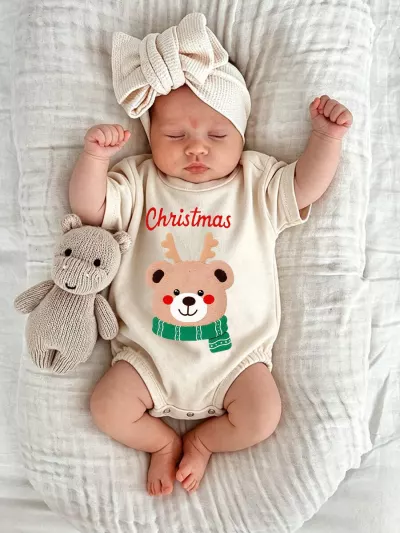
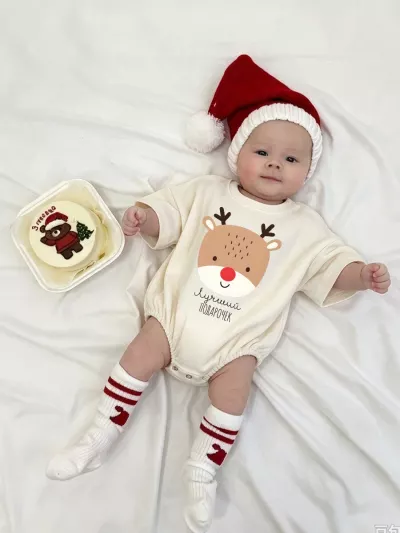
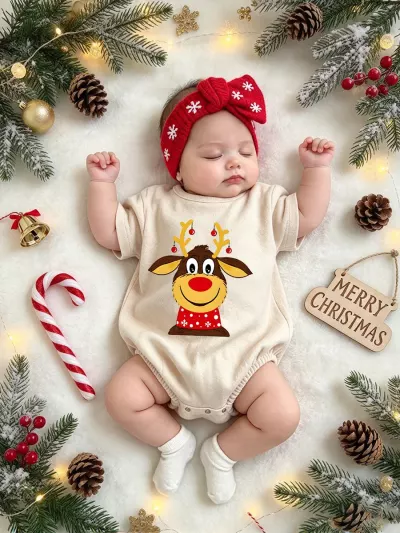
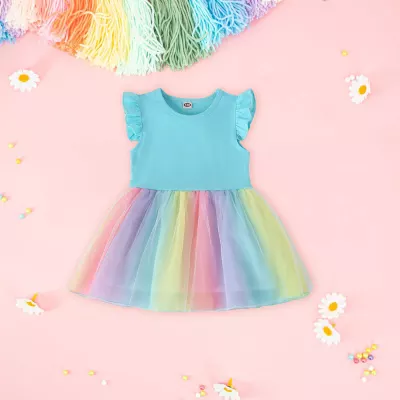
POD Printing & Customization: Which Printing Method Is Right for Your Product?

POD Printing & Customization: Which Method Fits Your Product?
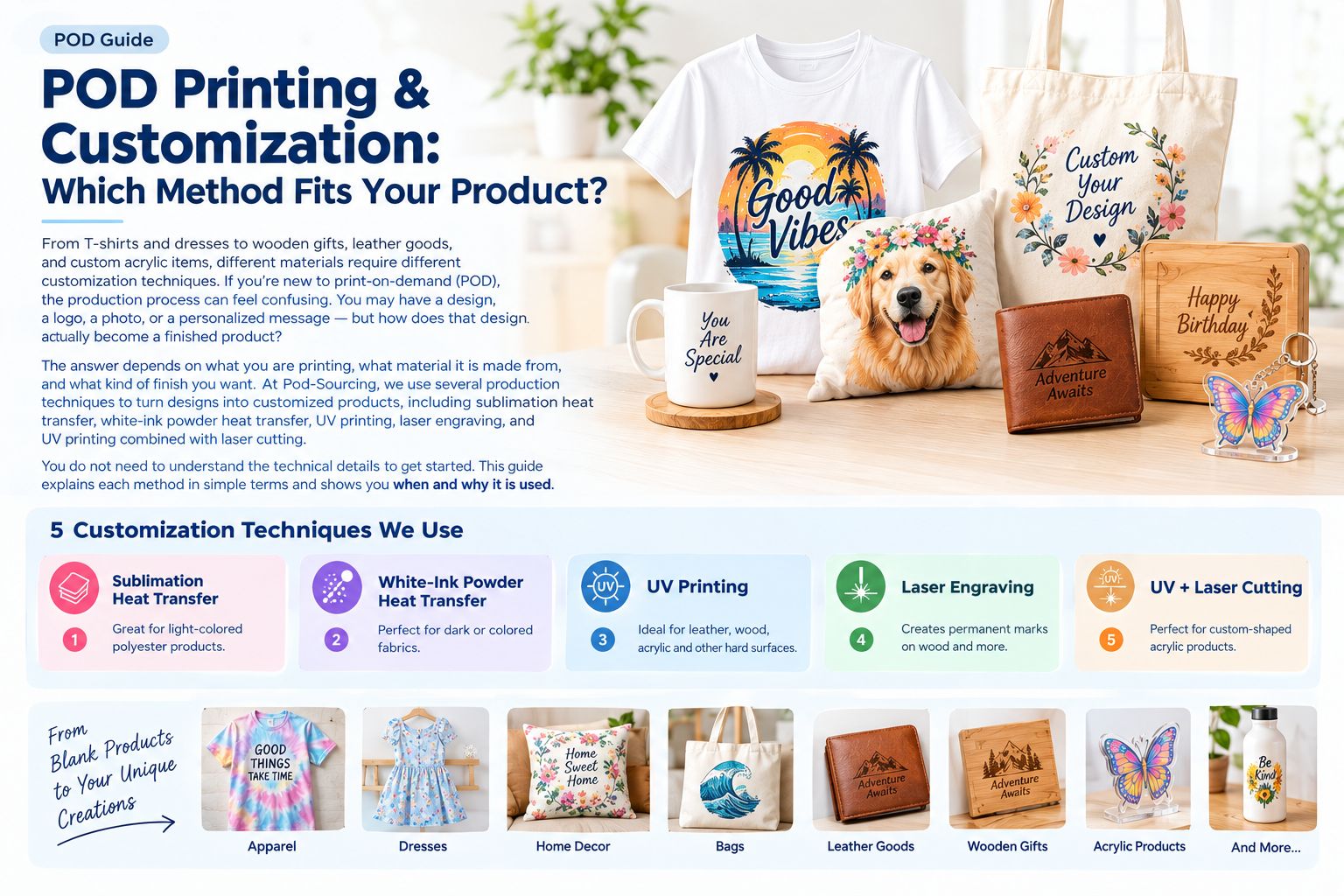
From T-shirts and dresses to wooden gifts, leather goods, and custom acrylic items, different materials require different customization techniques. If you are new to print-on-demand (POD), the production process can feel confusing. You may have a design, a logo, a photo, or a personalized message — but how does that design actually become a finished product?
The answer depends on what you are printing, what material it is made from, and what kind of finish you want. At Pod-Sourcing, we use several production techniques to turn designs into customized products, including sublimation heat transfer, white-ink powder heat transfer, UV printing, laser engraving, and UV printing combined with laser cutting.
You do not need to understand the technical details to get started. This guide explains each method in simple terms and shows you when and why it is used.
1. Sublimation Printing: Great for Light-Colored Polyester Products
What is sublimation printing?
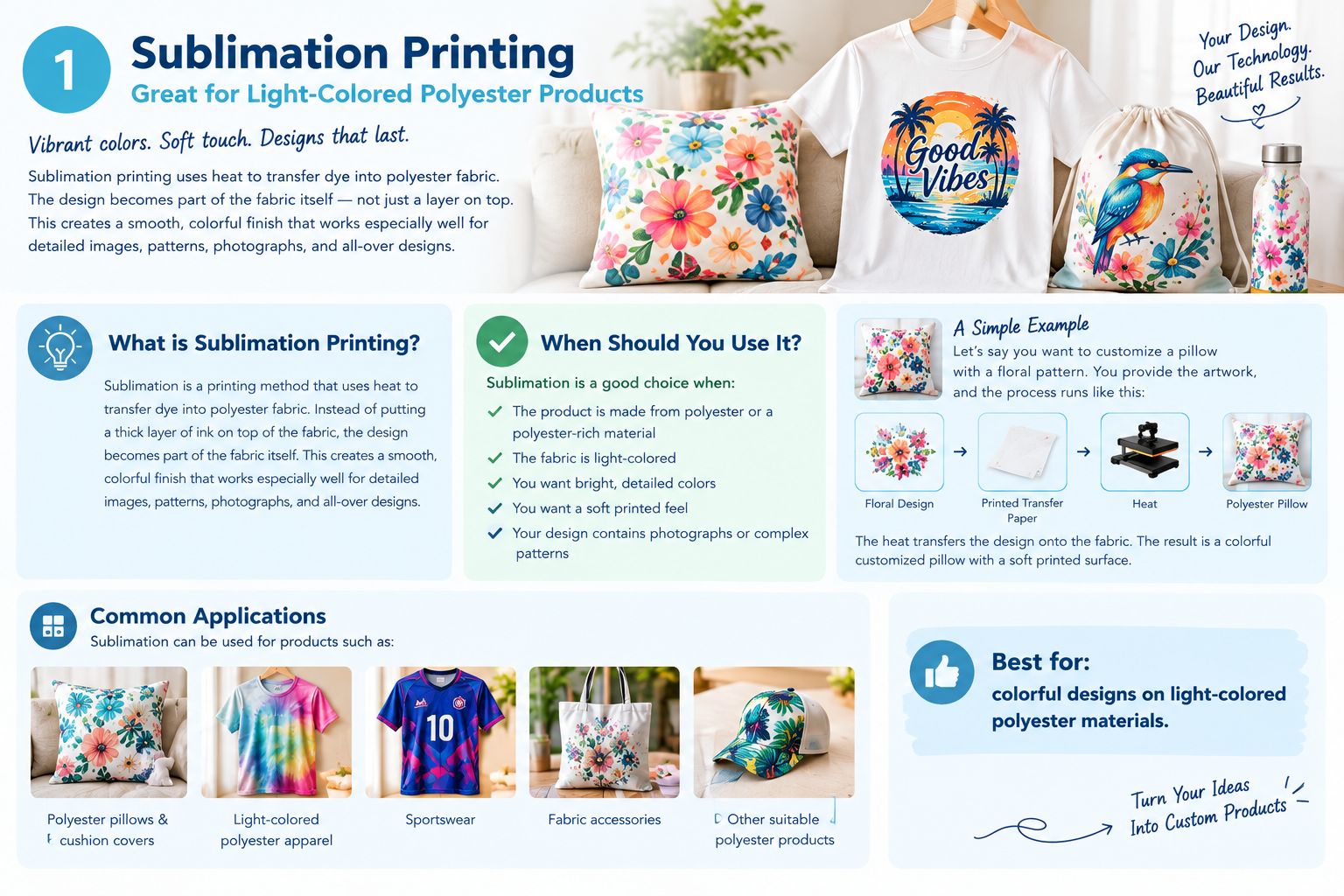
Sublimation is a printing method that uses heat to transfer dye into polyester fabric. Instead of putting a thick layer of ink on top of the fabric, the design becomes part of the fabric itself. This creates a smooth, colorful finish that works especially well for detailed images, patterns, photographs, and all-over designs.
When should you use sublimation?
Sublimation is a good choice when:
- The product is made from polyester or a polyester-rich material
- The fabric is light-colored
- You want bright, detailed colors
- You want a soft printed feel
- Your design contains photographs or complex patterns
A simple example
Imagine you want to customize a pillow with a floral pattern. You provide the artwork, and the process runs like this:
Floral Design → Printed Transfer Paper → Heat → Polyester Pillow
The heat transfers the design onto the fabric. The result is a colorful customized pillow with a soft printed surface.
Common applications
- Polyester pillows and cushion covers
- Light-colored polyester apparel
- Sportswear
- Fabric accessories
- Other suitable polyester products
Best for: colorful designs on light-colored polyester materials.
2. White-Ink + Powder Heat Transfer: Printing on Dark Fabrics
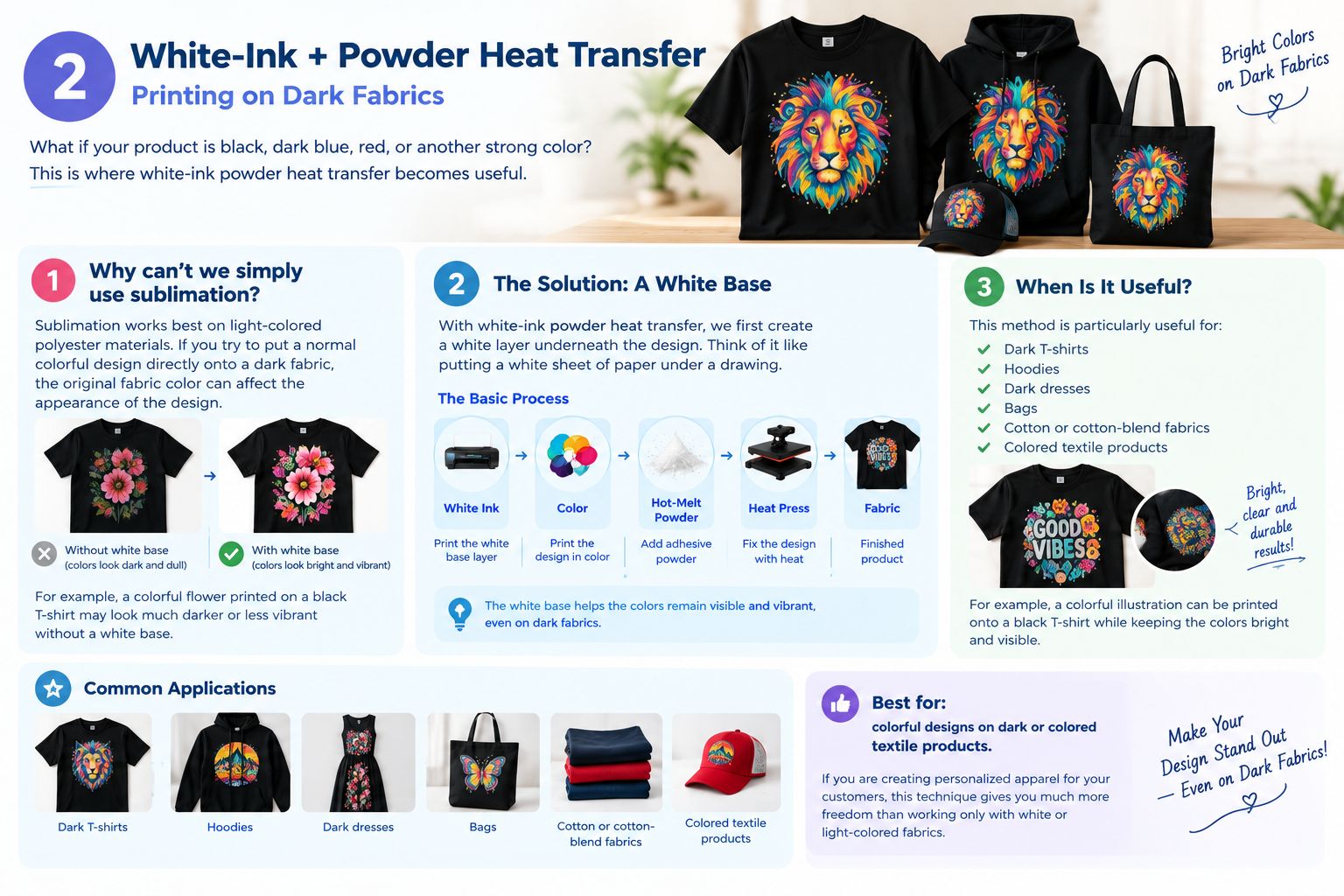
What if your product is black, dark blue, red, or another strong color? This is where white-ink powder heat transfer becomes useful.
Why can't we simply use sublimation?
Sublimation works best on light-colored polyester materials. If you try to put a normal colorful design directly onto a dark fabric, the original fabric color can affect the appearance of the design.
For example, imagine printing a colorful flower onto a black T-shirt. Without a suitable white base, the colors may look much darker or less vibrant than expected.
The solution: a white base
With white-ink powder heat transfer, we first create a white layer underneath the design. Think of it like putting a white sheet of paper underneath a drawing. The basic process is:
White Ink → Color → Hot-Melt Powder → Heat Press → Fabric
The white base helps the colors remain visible and vibrant, even on dark fabrics.
When is it useful?
This method is particularly useful for:
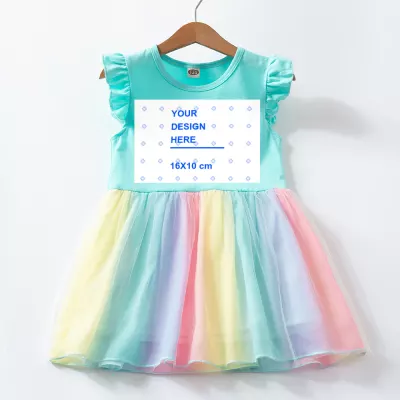
- Dark T-shirts
- Hoodies
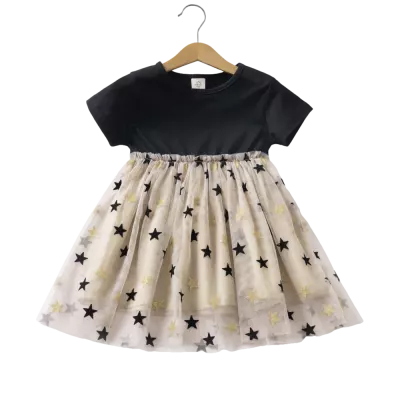
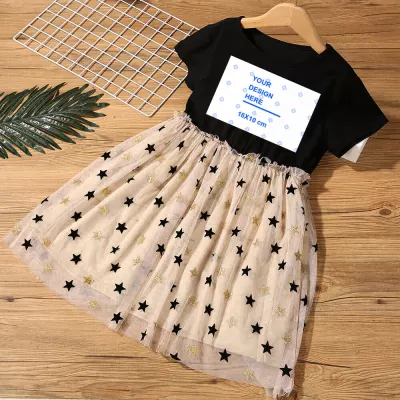
- Dark dresses
- Bags
- Cotton or cotton-blend fabrics
- Colored textile products
For example, a colorful illustration can be printed onto a black T-shirt while keeping the colors bright and visible.
Best for: colorful designs on dark or colored textile products. If you are creating personalized apparel for your customers, this technique gives you much more freedom than working only with white or light-colored fabrics.
3. UV Printing: Custom Designs on Hard Surfaces
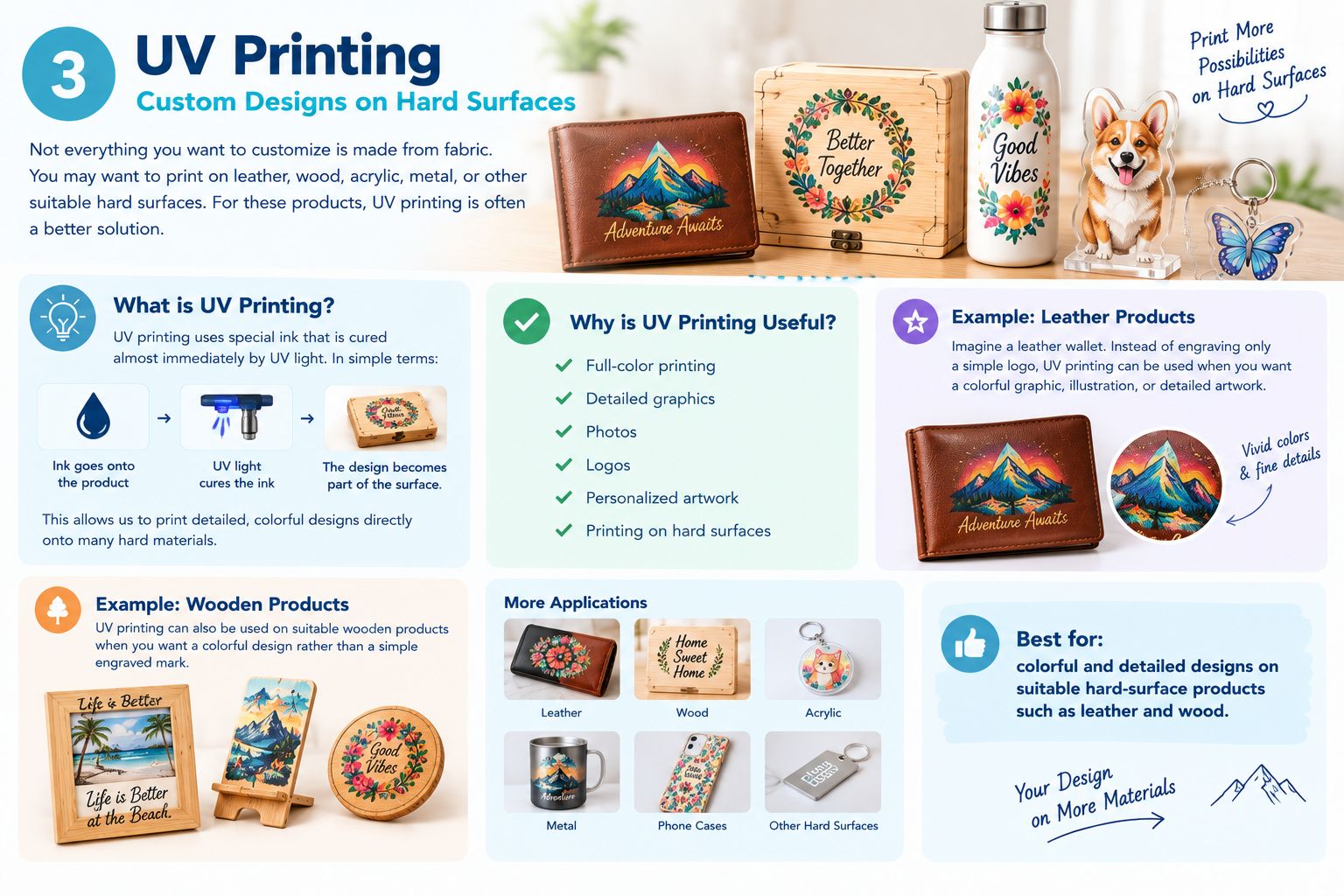
Not everything you want to customize is made from fabric. You may want to print on leather, wood, acrylic, metal, or other suitable hard surfaces. For these products, UV printing is often a better solution.
What is UV printing?
UV printing uses special ink that is cured almost immediately by UV light. In simple terms:
Ink goes onto the product → UV light cures the ink → The design becomes part of the surface.
This allows us to print detailed, colorful designs directly onto many hard materials.
Why is UV printing useful?
- Full-color printing
- Detailed graphics
- Photos
- Logos
- Personalized artwork
- Printing on hard surfaces
Example: leather products
Imagine a leather wallet. Instead of engraving only a simple logo, UV printing can be used when you want a colorful graphic, illustration, or detailed artwork.
Example: wooden products
UV printing can also be used on suitable wooden products when you want a colorful design rather than a simple engraved mark.
Best for: colorful and detailed designs on suitable hard-surface products such as leather and wood.
4. Laser Engraving: When You Want the Design to Become Part of the Product
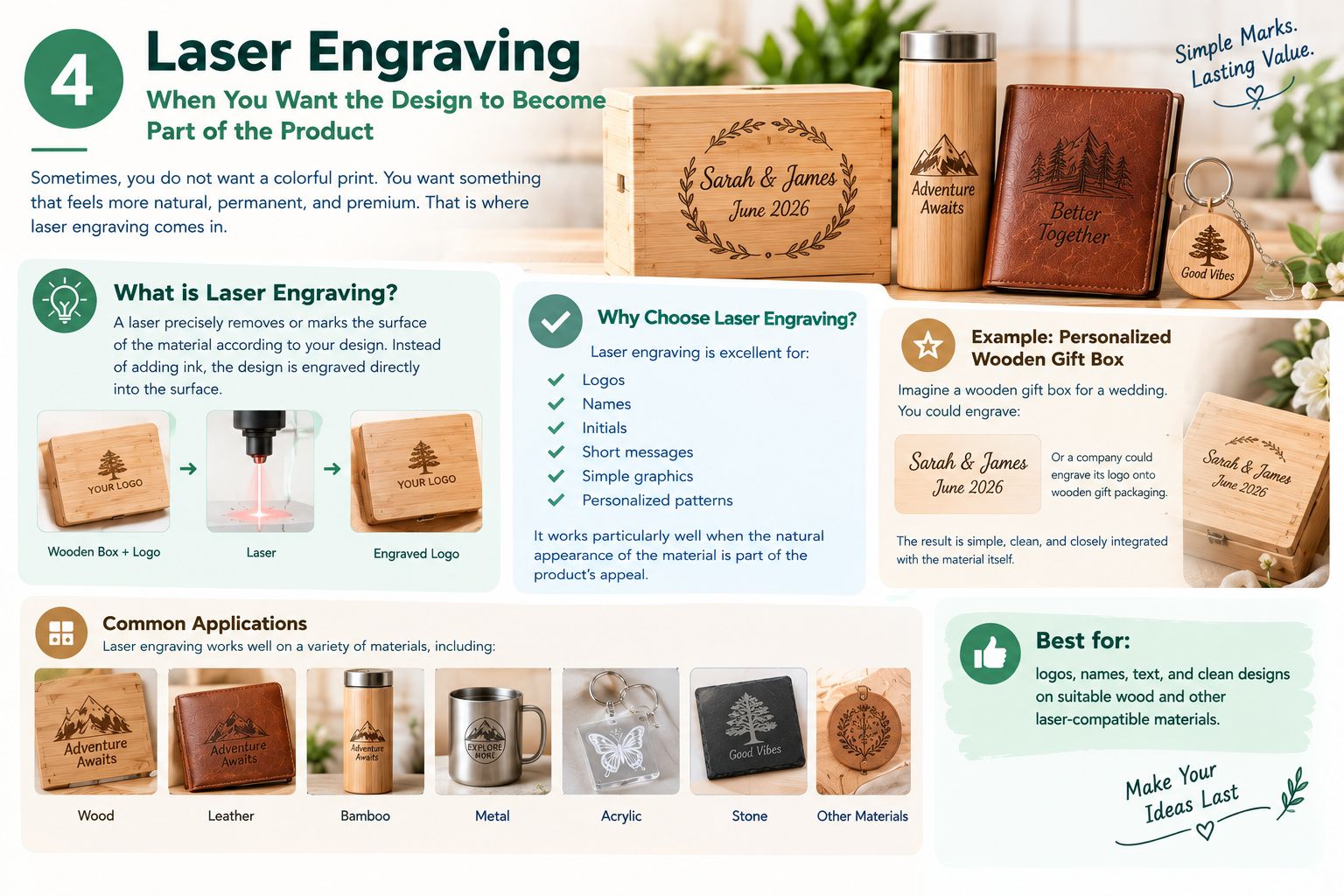
Sometimes, you do not want a colorful print. You want something that feels more natural, permanent, and premium. That is where laser engraving comes in.
What is laser engraving?
A laser precisely removes or marks the surface of the material according to your design. Instead of adding ink, the design is engraved directly into the surface. For example:
Wooden Box + Logo → Laser → Engraved Logo
Why choose laser engraving?
Laser engraving is excellent for:
- Logos
- Names
- Initials
- Short messages
- Simple graphics
- Personalized patterns
It works particularly well when the natural appearance of the material is part of the product's appeal.
Example: personalized wooden gift box
Imagine a wooden gift box for a wedding. You could engrave:
Sarah & James
June 2026
Or a company could engrave its logo onto wooden gift packaging. The result is simple, clean, and closely integrated with the material itself.
Best for: logos, names, text, and clean designs on suitable wood and other laser-compatible materials.
5. UV Printing + Laser Cutting: Custom-Shaped Acrylic Products
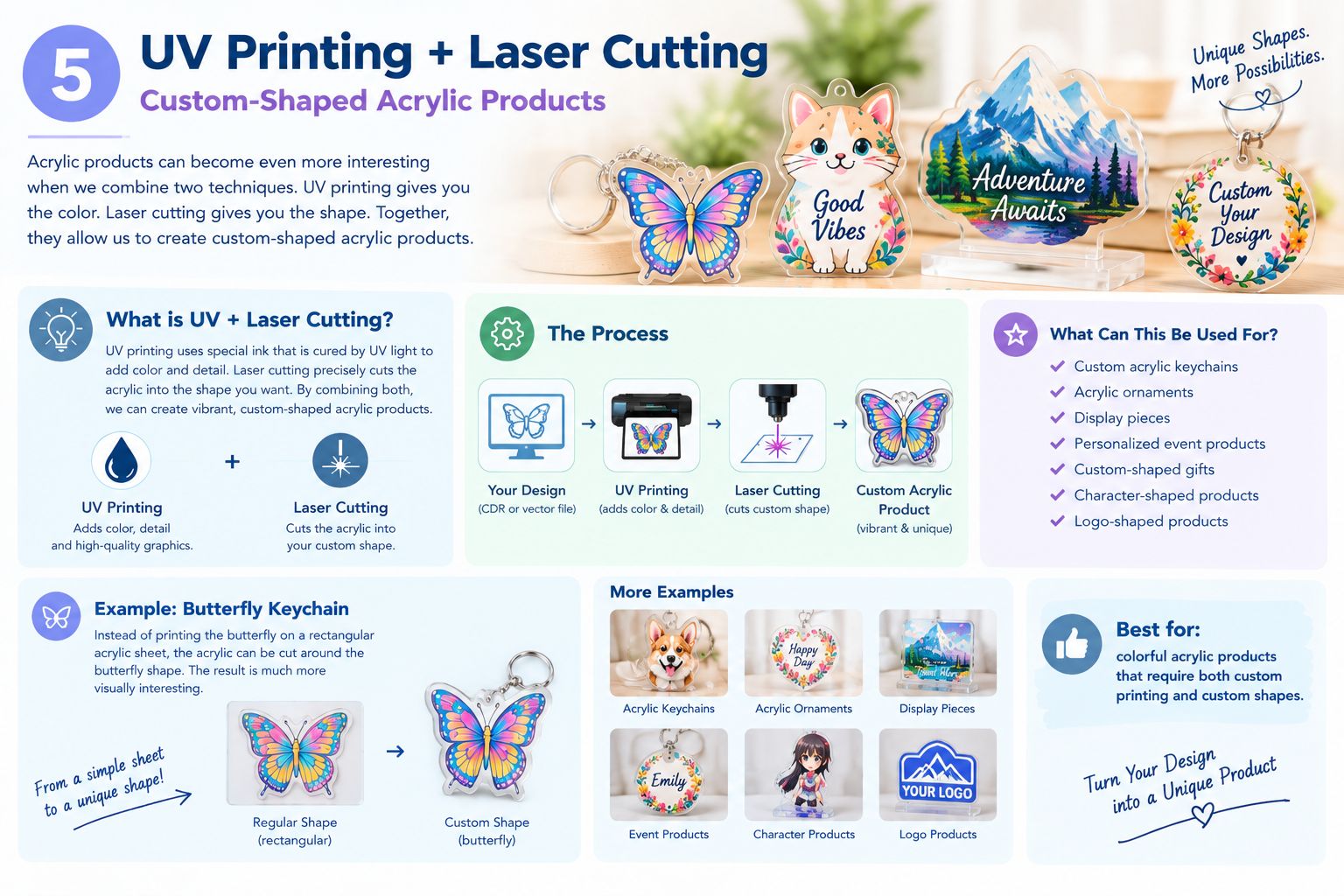
Acrylic products can become even more interesting when we combine two techniques. UV printing gives you the color. Laser cutting gives you the shape. Together, they allow us to create custom-shaped acrylic products.
For example, you may have a design in a CDR or other suitable vector format. The process can be:
Your Design → UV Printing → Laser Cutting → Custom Acrylic Product
Instead of making every product a simple rectangle or circle, we can cut around the shape of your design.
What can this be used for?
- Custom acrylic keychains
- Acrylic ornaments
- Display pieces
- Personalized event products
- Custom-shaped gifts
- Character-shaped products
- Logo-shaped products
Imagine a butterfly design. Instead of printing the butterfly on a rectangular acrylic sheet, the acrylic can be cut around the butterfly shape. The result is much more visually interesting.
Best for: colorful acrylic products that require both custom printing and custom shapes.
Which POD Printing Method Should You Choose?
You do not need to memorize all the technical terms. A simple way to think about it is:
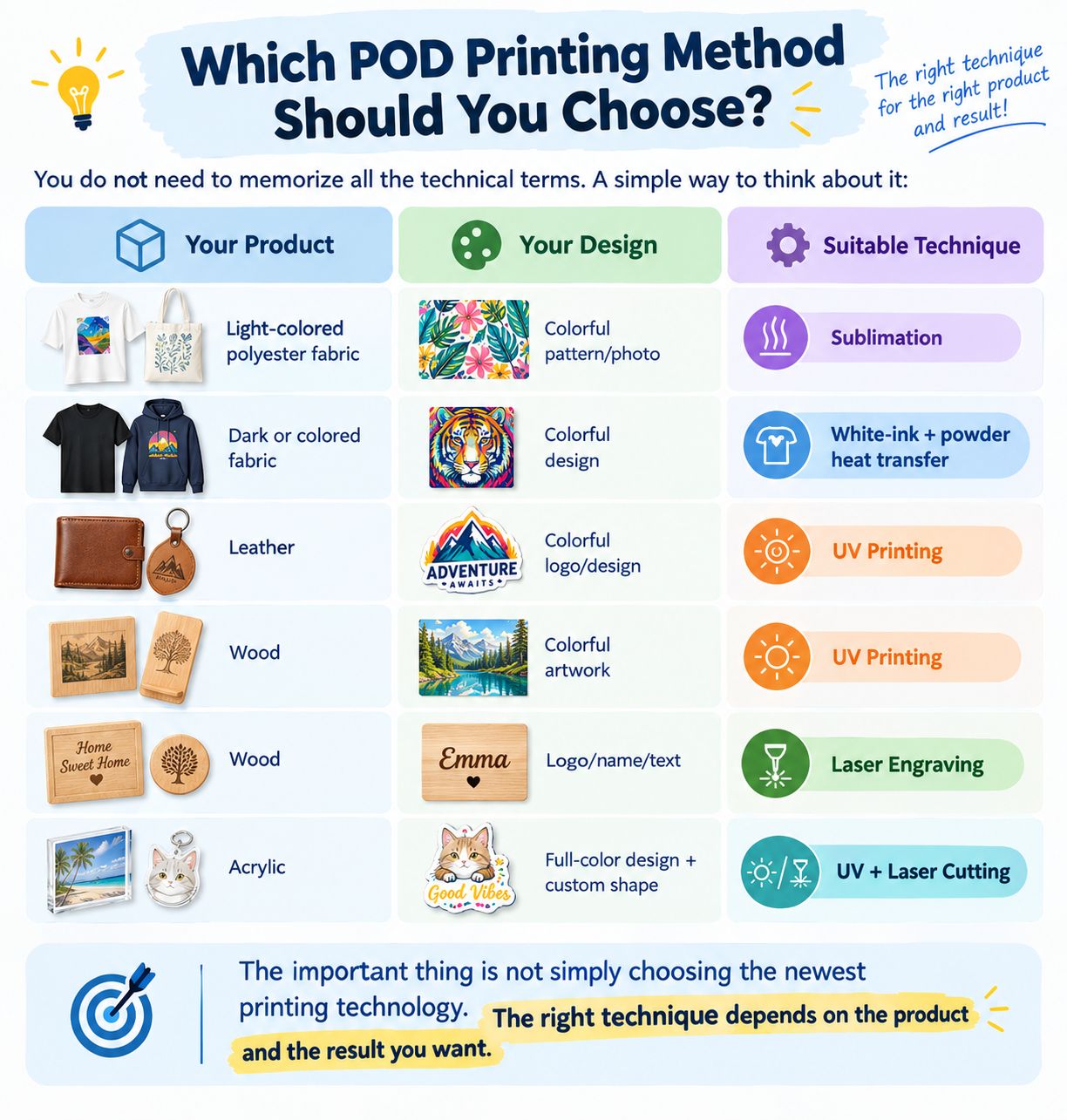
The important thing is not simply choosing the newest printing technology. The right technique depends on the product and the result you want.
What If You Don't Know Which Technique to Use?
That is completely normal. You do not need to become a printing expert before creating a customized product. Start with three simple questions.
1. What is the product made of?
Is it fabric, polyester, cotton, leather, wood, or acrylic?
2. What do you want to put on it?
Is it a photo, a colorful illustration, a logo, a name, text, or a simple engraving?
3. What kind of finish do you want?
Do you want bright full-color printing, a soft textile print, a natural engraved look, or a custom shape?
Once you know these three things, choosing the production method becomes much easier.
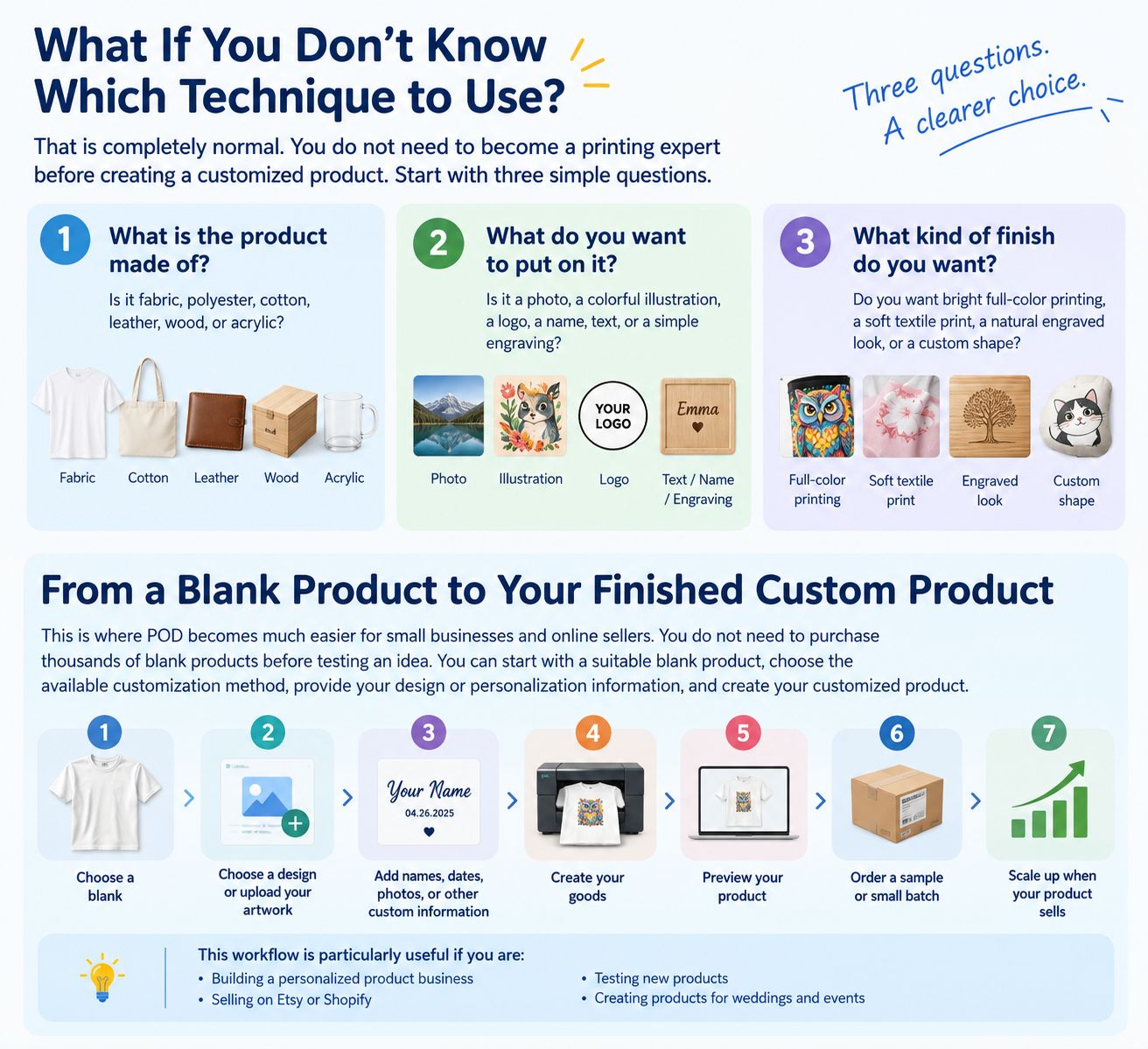
From a Blank Product to Your Finished Custom Product
This is where POD becomes much easier for small businesses and online sellers. You do not need to purchase thousands of blank products before testing an idea. You can start with a suitable blank product, choose the available customization method, provide your design or personalization information, and create your customized product.
- Choose a blank
- Choose a design or upload your artwork
- Add names, dates, photos, or other custom information
- Create your goods
- Preview your product
- Order a sample or small batch
- Scale up when your product sells
This workflow is particularly useful if you are building a personalized product business, selling on Etsy or Shopify, testing new products, or creating products for weddings and events.
POD Is Not Just About Printing
When people hear "POD," they often think only about printing a T-shirt. But modern POD can cover a much wider range of customized products. A single customization workflow can potentially lead to:
- Apparel
- Children's clothing
- Bags
- Wooden gifts
- Leather products
- Drinkware
- Accessories
- Acrylic products
- Personalized packaging
- Event and wedding products
The key is matching the right blank product with the right production technique. That is what makes a POD supply chain flexible.
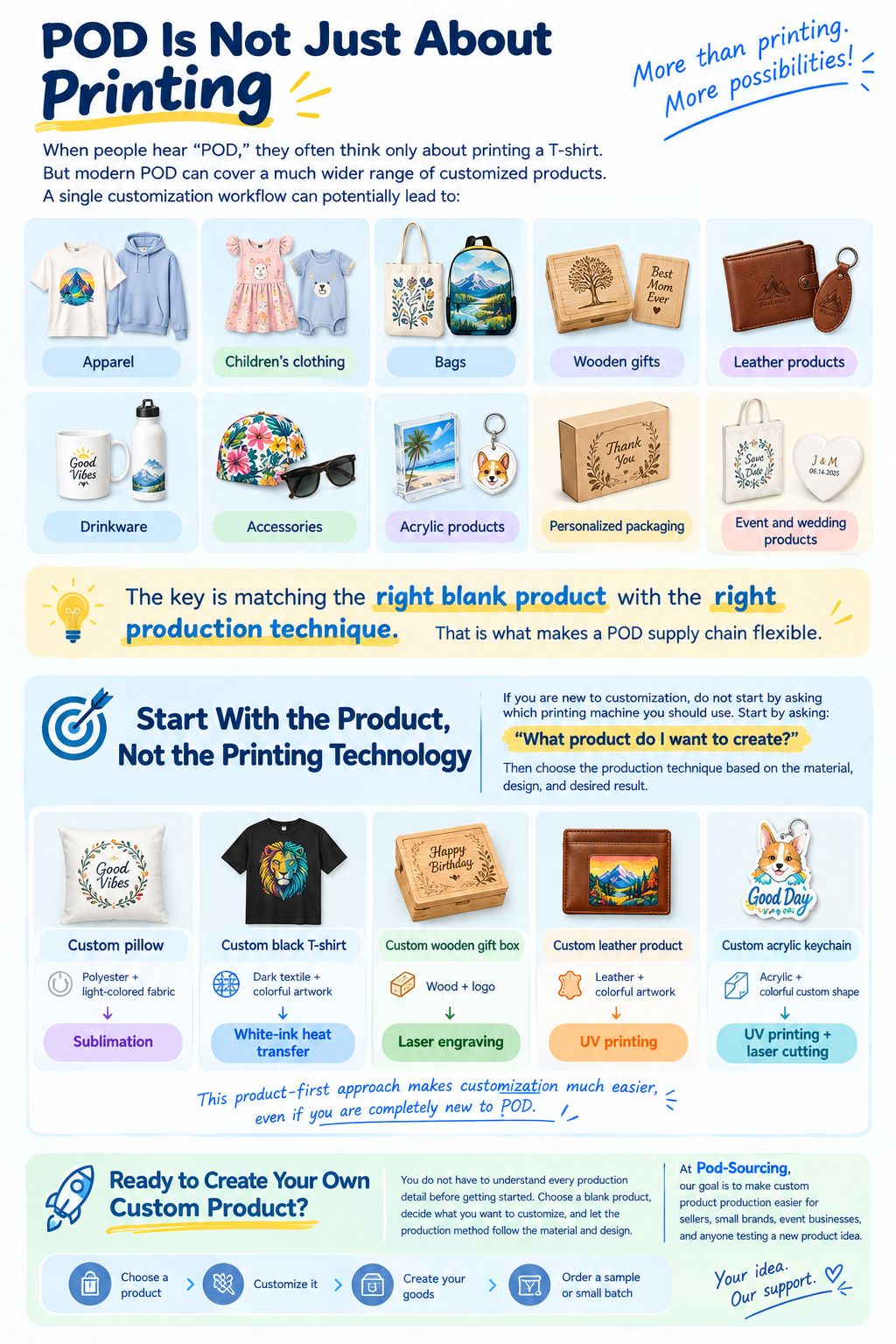
Start With the Product, Not the Printing Technology
If you are new to customization, do not start by asking which printing machine you should use. Start by asking: "What product do I want to create?" Then choose the production technique based on the material, design, and desired result.
- Custom pillow: polyester + light-colored fabric → sublimation
- Custom black T-shirt: dark textile + colorful artwork → white-ink heat transfer
- Custom wooden gift box: wood + logo → laser engraving
- Custom leather product: leather + colorful artwork → UV printing
- Custom acrylic keychain: acrylic + colorful custom shape → UV printing + laser cutting
This product-first approach makes customization much easier, even if you are completely new to POD.
Ready to Create Your Own Custom Product?
You do not have to understand every production detail before getting started. Choose a blank product, decide what you want to customize, and let the production method follow the material and design.
At Pod-Sourcing, our goal is to make custom product production easier for sellers, small brands, event businesses, and anyone testing a new product idea. Choose a product, customize it, create your goods, and order a sample or small batch.
Author's Latest
- How Youth Sports Teams and Clubs Can Get Custom Tote Bags and Keychains in Time for December Tournaments and Holiday Parties
- When to Order Custom Christmas Gifts in Bulk: A 2026 Timeline From the Factory Floor
- What Is the Best Website for Buying Personalized Gifts?
- Why I Built Pod-Sourcing: Custom Gifts Without the Five-Figure Minimum
- The Complete Guide to Cross-Border Import Taxes: Where Does Your Money Actually Go?
- How to Source Bulk Custom Gifts for Weddings and Graduations: A Complete Guide for B2B Buyers
Top 10 Hot Search
- 1 How Youth Sports Teams and Clubs Can Get Custom Tote Bags and Keychains in Time for December Tournaments and Holiday Parties
- 2 When to Order Custom Christmas Gifts in Bulk: A 2026 Timeline From the Factory Floor
- 3 What Is the Best Website for Buying Personalized Gifts?
- 4 Why I Built Pod-Sourcing: Custom Gifts Without the Five-Figure Minimum
- 5 POD Printing & Customization: Which Printing Method Is Right for Your Product?
- 6 The Complete Guide to Cross-Border Import Taxes: Where Does Your Money Actually Go?
- 7 How to Source Bulk Custom Gifts for Weddings and Graduations: A Complete Guide for B2B Buyers